LII Verona
What3words – climbing.stump.cowboy
Construction - 30AD
Capacity - 30,000
Visited March 2026
Status – Amphitheatre peeled of most of its outer wall but stunningly well preserved and a must-visit. Survived and restored as a working venue for events, opera and concerts
When conversation turns to Roman Amphitheatres, the question ‘Have you been to the one in Verona?’ often comes up. The answer, as of March 2026, is yes. Substantially complete and fully functioning, it is quite a sight as you approach the Piazza Bra which provides its setting. Without its marble cladding and arched curtain wall, the exposed pink-hued valpolicella stone of the surviving structure, has, in the evening light, something of the colour of a peeled pink grapefruit.
The Roman city of Verona occupied an easily defensible bend in the River Adige. To the south of and outside the walls they built the amphitheatre, completed in 30AD. Historians have argued the toss over its date, with Luigi Beschi advocating mid 3rd century, and Pirro Marconi (for those in the know, absolutely nothing to do with the guitar player from Adam and the Ants) pushing for 2nd-3rd century. The current consensus is late Augustan, early Claudian and the structure bears stylistic and architectural similarities with that of Pula. Avoiding the pitfalls of having to expand or replace a structure that couldn’t accommodate a growing population, they went large from the start with a 30,000 seat venue surrounded by a decorated curtain wall with three rows of arches.
During decline of the empire and barbarian invasions of the 3rd century, sections of wall were added linking it with the city defences. This didn’t apparently stop a successful seige by Constantine in 312 (Depicted and celebrated of course on the triumphal Arch of Constantine in Rome).
Verona fell within the medieval kingdom of the Ostragoth Theodoric the Great, and bits of amphitheatre have been found reused in his 6th century defences. By the 12th century the amphitheatre was still being referred to as the ‘house of Theodoric’.
Over the centuries the flat plains below the Dolomites experienced floods (including in 569) and earthquakes (in 1116 and 1117) which contributed towards raising the ground level around the structure and demolishing the un-quarried parts of the outer wall (which still appeared intact in a mid 10th century depiction). Quarrying proceeded until the 13th century when the first statutes to protect it appeared. At that time the arena served as a venue for professional fights undertaken to resolve legal disputes (mentioned in Dante’s Inferno) heretic burning (200 Cathars in 1278) a residence/workplace for the city’s prostitutes and a jousting arena.
Verona seems to have been in the game early when Renaissance attitudes towards history began to emerge. Prostitutes were evicted, merchants asked in, and architectural surveys and plans for restoration started in the 1500s. Things gathered pace in the 1700s. A metre and a half of earth was removed from the arena floor and the remainder of the outer wall was stabilised and restored. Over time occasional jousting spectacles gave way to theatrical activity as well as bull-baiting with dogs. Napoleon Bonaparte turned up for a bull hunt in 1808. In 1816 French rule ended and Verona became part of Austrian Lombardy-Venetia. The municipality evicted 36 tenants and assigned 42 arcades for storage use and drew up a further work plan for restoration focused on removing two metres of flood sediment from the surroundings, demolishing buildings and setting out the Piazza Bra. Bull-baiting gave way to equestrian events, circuses, cycle races, hot air balloon displays, gymnastics and comedies in the Imperial Austrian era. Joining the kingdom of Italy in 1866 was celebrated in the arena in the presence of King Victor Emmanuel II and led to further restoration and repair programmes.
Whilst the first Opera season took place in 1856, it was the launch of the Arena di Verona Festival in 1913 with a performance of Aida which established it as the world’s largest open-air opera venue.
The complete interior continues to provide a working venue for the annual season of opera, sports and rock concerts. My visit took place a week after it had hosted the closing ceremony of the winter Olympics, consequently the whole structure was cordoned off with Heras fencing whilst a hi-vis army laboured (at an Italian pace) to dismantle and remove the elaborate staging and security measures. I nipped back a week later and they were still at it. A look around inside will have to await another trip.
It’s Only Rock & Roll
Given its astonishing state of preservation and pretty much uninterrupted use as an entertainment venue since its construction, it’s no surprise that Verona has been hosting rock concerts in the downtime outside opera season. The ‘aristocracy’ have played here: Springsteen, McCartney, Elton John, Radiohead, Pearl Jam, Zucchero (lots), Simple Minds, King Crimson, Mark Knopfler, Duran Duran (coming in 2026) and er.. Italian prog rock outfit ‘Pooh’ who for some reason don’t attract a great deal of international interest. (No sign of Sting but the blighter’s still on the road somewhere).
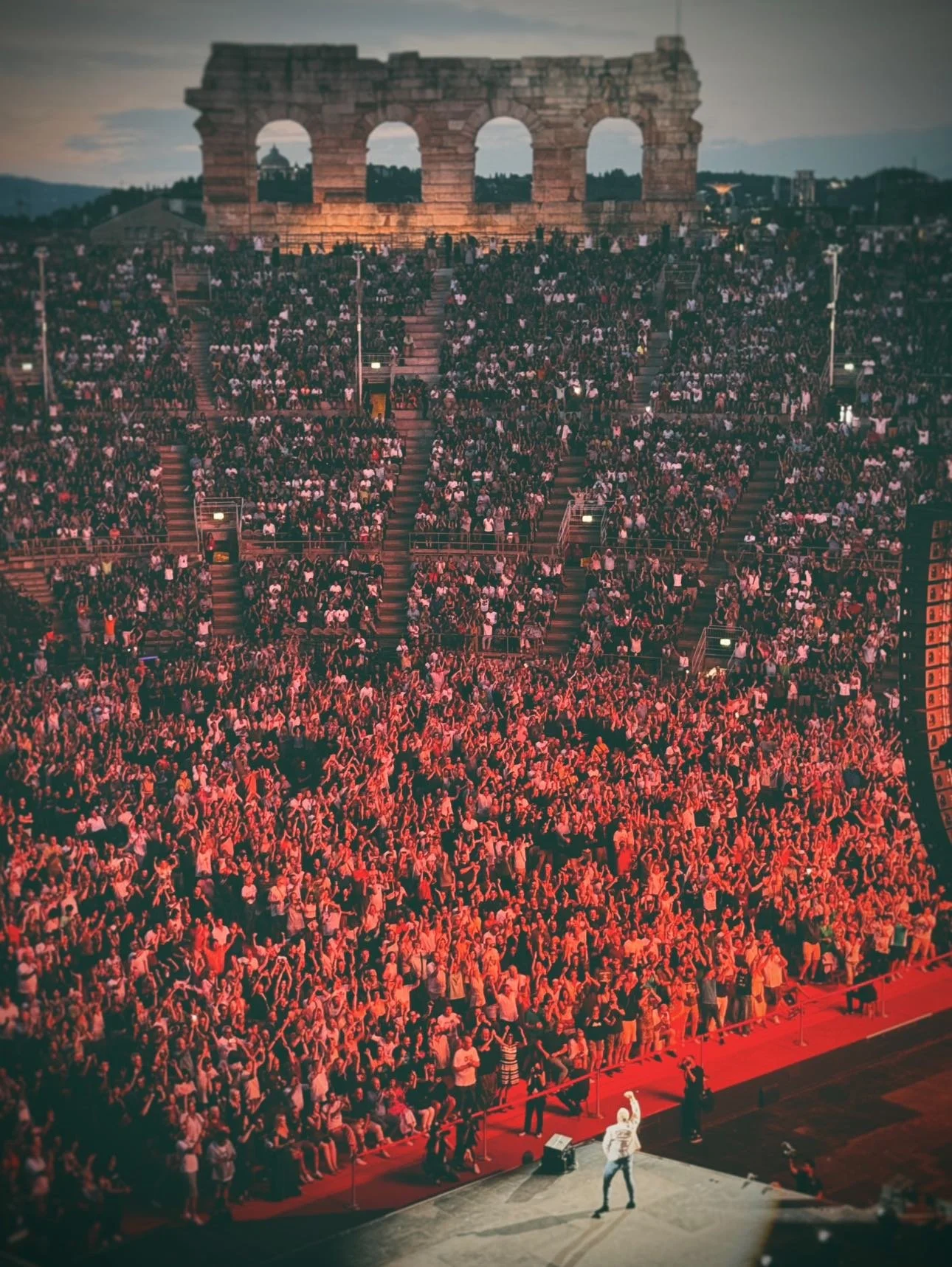
Simple Minds 2025
Mid 10th Century Verona - Raterian Iconography